The elephant in the room called lifestyle
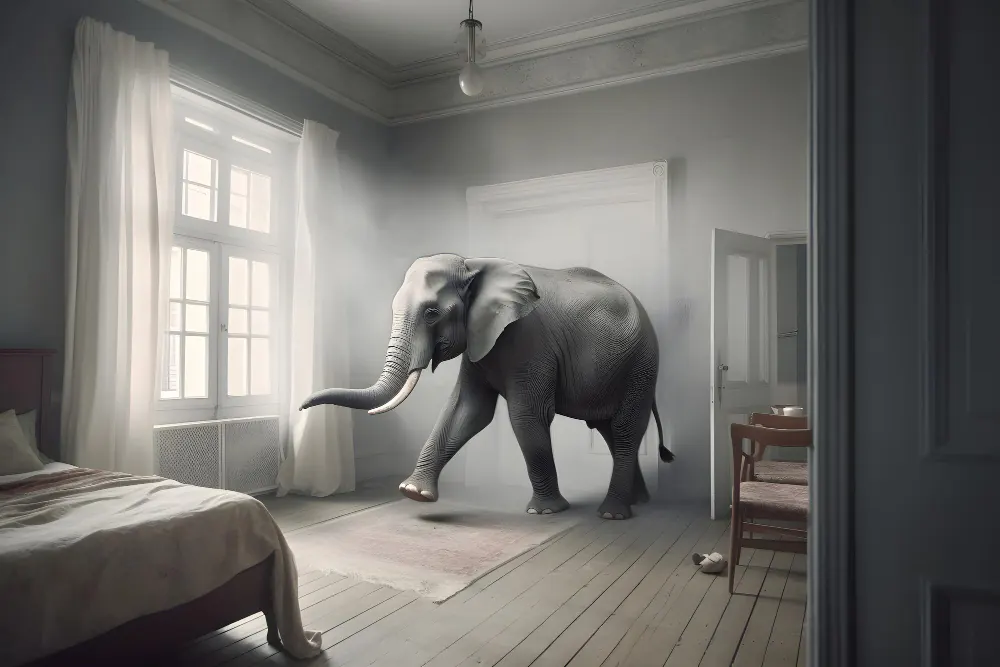
About cancer, lifestyle, and what we would rather not hear – but what is worth knowing.
A note first: “the elephant in the room” is an English expression for something everyone sees, everyone feels, but nobody wants to talk about. The beast stands in the middle of the space, but out of politeness, discomfort or unwillingness we all look around it. That is what this blog means. No more, no less. And certainly not a reference to weight or body shape – that is completely beside the point here.
There are subjects you don’t just bring up. Not at the kitchen table, not at birthday parties, and honestly not always in the GP’s consulting room either. Cancer is one of those subjects. The word alone feels heavy. And understandably so – because cancer touches everyone somewhere, in one way or another.
But there is something we as a society have been collectively looking away from for years. Not out of ignorance. More because it is uncomfortable. Because it touches on habits we love. On choices that are our own.
And that is exactly why it is worth bringing it up.
What the science says
In early 2026 the World Health Organization (WHO) and its research institute IARC published one of the most extensive cancer analyses ever. Data from 185 countries, 36 types of cancer, and a careful calculation of 30 risk factors.
The conclusion: almost 40% of all new cancer cases worldwide can be traced back to factors we can influence ourselves.
That is no small claim. That is 7.1 million people a year, a large share of whom – in theory – could have gone a different way.
The researchers themselves add something remarkable: this figure is probably an underestimate. Some nutrition-related factors could not be included because the evidence for them is not yet complete enough worldwide. So the real percentage may be even higher.
The big three
If you look at what weighs heaviest among those 30 risk factors, three stand out:
Smoking is number one. Responsible for 15% of all new cancer cases worldwide. Not surprising – but the scale remains impressive.
Infections come second, accounting for around 10%. Think of HPV (cervical cancer), hepatitis B and C, and the H. pylori bacterium (stomach cancer). Many of these infections can be prevented through vaccination or treated if they are detected early.
Alcohol is third, with around 3% of all cases. More modest in percentage, but not in impact – because alcohol raises the risk of several types of cancer at once, and that link has been established unambiguously in the scientific literature.
What else is on the list
Besides the big three, there are risk factors that make the news less often, but do contribute measurably:
Overweight. Insufficient exercise. Air pollution. Exposure to UV radiation. Certain substances in the workplace.
And then – for those reading this as a woman – there is something that stands out. For women, infections are the biggest avoidable risk factor (11%), followed by smoking (6%) and overweight (3%). That third point – overweight as a risk factor for cancer – is something that surprises many people. We know overweight as a risk factor for cardiovascular disease and for diabetes. But cancer? That link is less well known, and underexposed.


No pointing fingers
This is the point where this story goes in a different direction than you might expect.
Because this is not a call to feel guilty. Not about your smoking past, not about your drinking at parties, not about the kilos that have crept on over the past few years. That helps nobody, and it is not the intention of the research either.
What the research does show is that lifestyle matters. Not as a moral issue, but as a measurable reality. And that is a different tone.
Guilt paralyses. Knowledge liberates – if you can do something with it.
What you can do with it
The nice thing about this kind of research is that it also offers hope. Because if almost 40% of cases are linked to factors that can be influenced, then there is room. Not for perfection. But for movement.
Stopping smoking has – whatever your age – a direct effect on your risk.
Less alcohol means less risk. That already applies with a moderate reduction.
Moving more, eating healthier, staying at a healthy weight – they have become clichés precisely because they can be applied so broadly. But clichés don’t become clichés for nothing.
And vaccinations – for HPV, for hepatitis B – are, for certain groups, a concrete and effective way to reduce an infection-related cancer risk.
Small steps, stacked over time. No big sacrifices, no radical upheavals. Simply: letting the scales tip a little bit the other way.
In conclusion
Cancer will always remain partly unpredictable. Genetics plays a part. Chance plays a part. Not everything can be steered, and that is a reality we have to accept.
But 40% is not nothing. That is not a needle in a haystack – that is a substantial part of the story that we can write ourselves.
And perhaps that is exactly why it is worth calling the elephant in the room by its name now and then.
Sources: WHO/IARC Global Cancer Burden Analysis 2026, published in Nature Medicine.